Benefits of a Private 5G Campus Network
powered by WICONN

5G-based networks allow for high data rates and a very high density of end devices. At the same time, they score points with flexibility in Quality of Service, availability, and high security.

How do companies benefit from this in concrete terms?
If companies want to fully exploit the performance of the fifth generation of mobile communications, setting up their own local network in Germany is relatively straightforward.

When it comes to the advantages of 5G, public attention is usually focused on applications like autonomous driving, which require high data rates and low latency. But that is far from everything: 5G was the first mobile generation developed not only to connect people, but also machines and products, robots and sensors. In other words: people, places, and things. This requires high flexibility, security, and availability of the underlying technology. These are precisely the strengths of 5G when used in private campus networks.

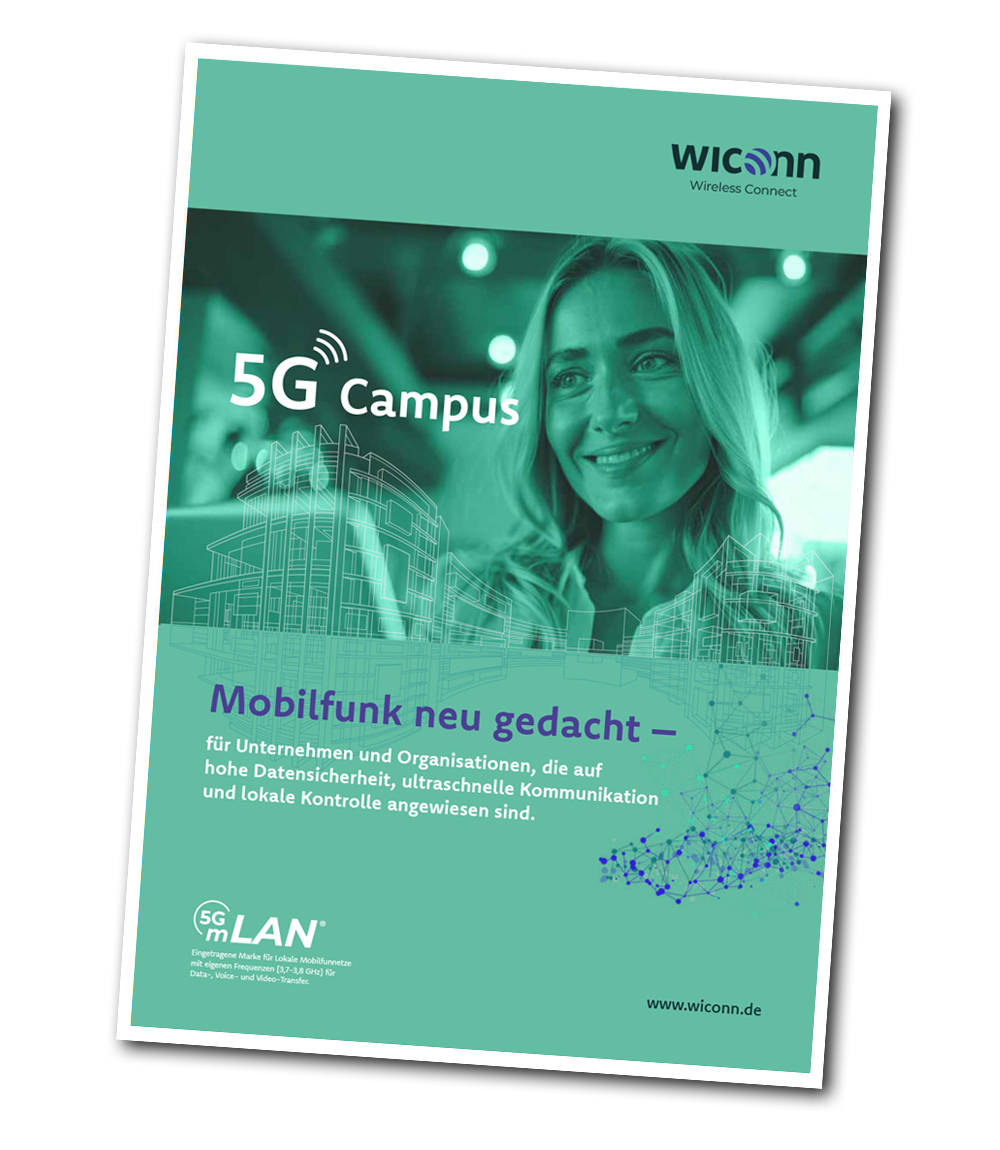
Solution Brochure:
5G campus networks as 5G mLAN –
Mobile communications reimagined

A 5G campus network is a strategic building block for creating high-performance, secure, and scalable communication infrastructures. State-of-the-art technology. Operationally in your hands.

Learn more in our 16-page solution brochure:
‍
- What is a 5G campus network powered by Wiconn?
- Benefits of a private 5G network
- Maximum security through controlled access
- Diverse use cases and applications
- Technical setup – explained simply
- Why is 5G technology so powerful?
- Wi-Fi and 5G – When does a 5G campus network make sense?
- From site to 5G campus network
- Your partner for 5G campus networks
- Operational Services
- What is your next step?

Download as PDF now:

Something went wrong. Please try again or contact us via email.
3 steps to successBenefitsDifferences in campus networks

Three steps to your customized 5G campus network

Our Approach

It begins with a consultation where we understand your needs in relation to your goals and identify specific challenges. Based on this, we develop customized network solutions tailored to your operational requirements and strategic objectives. We ensure seamless integration into your existing infrastructure, minimizing disruptions and maximizing efficiency.

Book a consultation

Our Mission

Our goal is to make state-of-the-art private 5G campus networks accessible to all organizational units. We strive to offer solutions that are not only powerful and efficient, but also secure and easy to manage. Through the continuous development of our private networks, we aim to exceed expectations and massively and sustainably increase the benefits and new business opportunities for our customers.

Our Vision

We envision a world where mobile data networks drive innovation, simplify life and work for everyone, increase productivity, and open up unimagined possibilities. Our goal is to ensure access to advanced mobile technology so that companies of all sizes can harness the full potential of 5G. By focusing on flexibility, scalability, and cost-efficiency, we plan, implement, and operate high-performance private networks.

The added value of a 5G campus network for you

You remain in full control of your own network and its areas of application at all times. This not only secures your mission-critical production processes and workflows, but also allows you to adapt the communication infrastructure to your needs at any time, with complete autonomy.

Ultra Low Latency
Shorter latency times of less than 1 millisecond (ms)

This is the gateway to real-time applications, especially because 5G enables seamless handover (from one antenna to another).

Very high bandwidths
with one Radio Unit (RU) - data rates of up to 20 Gbit/s in the downstream

Why is that?

5G adopts the highly efficient OFDMA access method (Orthogonal Frequency Division Multiple Access). Quadrature Phase-Shift Keying (QPSK), also known as four-phase modulation, continues to be used as a modulation scheme. This ensures that the air interface remains fundamentally backward compatible.

Additionally, since 3G/HSPA, Quadrature Amplitude Modulation (QAM) has been used. Amplitude modulation is combined with phase modulation! – these are QAM 16, QAM 32, QAM 64, and QAM 256, which denote the respective number of states that can be encoded simultaneously. The higher the density, the more information can be transmitted per unit of time. The data transmission rate increases under otherwise identical conditions. 5G also works with QAM 1024, which further increases spectral efficiency (SE) and transmits even more data per unit of time when needed.

Numerous participants in one cell

Multiple-input multiple-output (MIMO) antennas provide service to individual user devices through a process called beamforming, which adjusts the antenna transmission direction so that the maximum signal always reaches the intended device. Radio waves are bundled for this purpose, which, instead of the usual circular propagation of radio signals, allows for precise alignment of the signal toward the device. This enables data to be transmitted simultaneously to multiple mobile devices in the same frequency range. Additionally, there is less scattering of transmission power, which contributes to increased efficiency.

Data security in the 5G network

Cryptography, the encryption of information, also ensures data security in the 5G network.

In a 5G mobile network, there is a deliberate privacy advantage: you cannot be eavesdropped on via conventional catchers. Intercepting data becomes virtually impossible.

In a private network, there is physical network access control—because without an authenticated SIM card, participation in data traffic is impossible.

Flexibility for individual use cases

In a private 5G network, individual use cases can be configured in a tailored manner. The network core acts as the brain of the entire system, providing the foundation and communicating with interfaces, for example, to the local LAN or the public mobile network (hybrid architecture). Today, numerous common use cases (group communication, IoT integration, robotics, etc.) as well as custom-designed applications can be realized.

High reliability of data networks

5G networks can be operated with high availability. All components, from the core to the BU, RU, and antennas, can be designed in HA mode.

Low TCO – high cost-efficiency

Thanks to their unprecedented technical features, investments in a 5G campus network are very secure. In addition, a 5G campus network provides a highly stable and high-performance data network for data, voice, and video applications. You will be surprised at how cost-effectively we can offer you a 5G campus solution as a project-based engagement or as an "as-a-service" model. Also, keep in mind that the effort required for cabling in a LAN or WLAN is massively reduced, which contributes to cost-efficiency.

Differences between campus networks

Private campus networks

Private campus networks are available exclusively to a specific group of users, such as company employees or university students. They offer a higher level of security compared to public campus networks because they are intended for internal use and can be better protected; this also applies to capacity and performance. Furthermore, they offer high flexibility, as private networks can be configured to meet the specific needs of a company or institution.

Hybrid campus networks

Hybrid campus networks have interfaces to public mobile networks. This interface is managed within the core unit of the 5G campus network. This gives users the option to access applications from the private network via the public 5G campus network. Consequently, when implementing use cases such as group communication, both internal calls and external connections to the public network are possible. Often, private 5G networks are also implemented using slices—comparable to VLANs—from the public mobile network. In these configurations, the operation and ownership are usually not under the control of the user.

5G signal amplification in buildings

Inside buildings, the 5G signal can be weakened by obstacles such as walls, ceilings, and other objects. To improve signal strength, there are several measures you can take:

Relay antennas

Antennas that boost the signal inside buildings by relaying it from a specific point.

Repeaters

Devices that boost the signal by relaying it from one location in the building to another.

Small Cells

Small base stations that can be installed inside buildings to boost the signal.

Distributed Antenna Systems (DAS)

Networks of antennas distributed throughout a building to boost the signal.

Window film

A special window film can be used to allow the signal to pass through windows that would otherwise block it.

These are some of the ways to boost 5G signals inside buildings. However, it is important to note that the best solution depends on factors such as the size and configuration of the building, the number of users, and signal strength requirements.

Connectivity without boundaries

Your request is important to us. We would be happy to advise you personally and, if you wish, work with you to develop a tailored solution.

Your inquiry

Thank you!

Thank you for your inquiry.
We will get back to you shortly.
Something went wrong. Please try again or contact us via email.

Subscribe to our newsletter and get the latest IT news delivered straight to your inbox.